Stock Transfer
In PrismERP, Inventory Transfer manages the movement of products between inventories or branches. Users can create Transfer Requests to specify which products, quantities, and source inventory need to be transferred. Once approved, a Transfer Order is created to record the dispatch of products to the destination inventory. Each request and order captures details such as branch, inventory, product, and delivery dates, and can be tracked in the corresponding lists. Users can view operational and accounting information for each transfer, and generate reports for documentation and tracking purposes.
Add Transfer Request
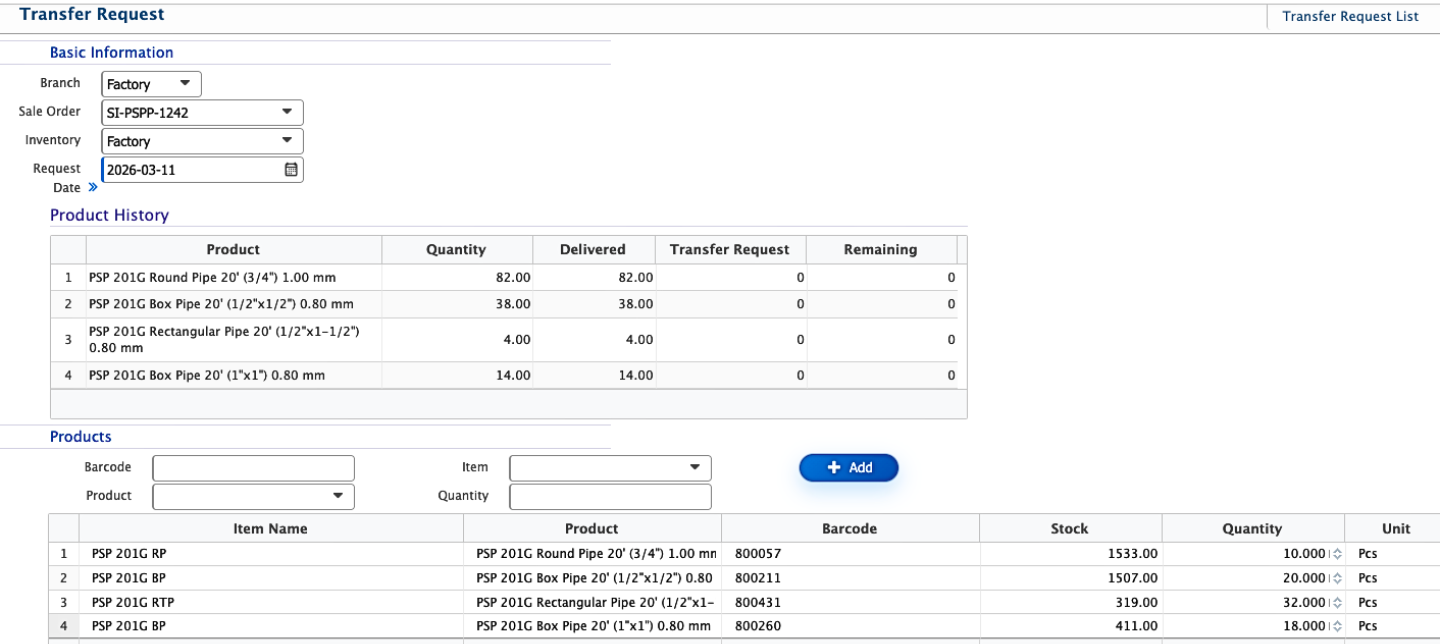
| Field | Action |
|---|---|
| Branch | Select the branch where the transfer request is created. |
| Sale Order | Select the related sale order if the transfer request is linked to a specific order. |
| Inventory | Select the inventory location from which the products will be transferred. |
| Request Date | Enter or select the date when the transfer request is created. |
| Products Barcode | Enter the barcode to quickly search and add products to the transfer request. |
| Item | Select the item or product category associated with the product. |
| Product | Select the product that needs to be transferred. |
| Quantity | Enter the quantity of the product requested for transfer. |
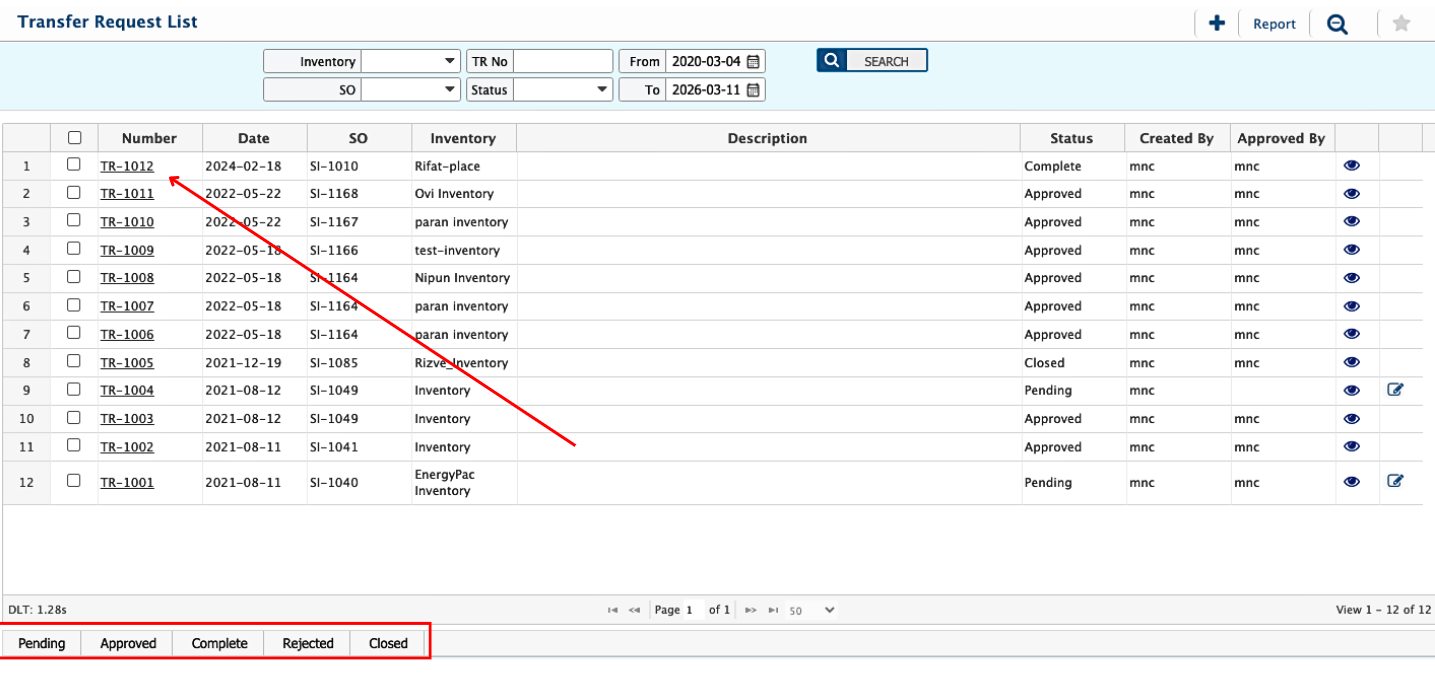
After a Transfer Request is added, it immediately appears in the Transfer Out List. Users can use the search panel to filter and locate a specific request. Each request has a status that reflects its current stage: Pending, Accepted, Rejected, or Closed. Users can update the status at any point, and even edit a request after it has been closed if adjustments are needed. Once the transfer process is fully completed, the request can be marked as Closed to finalize it in the system.
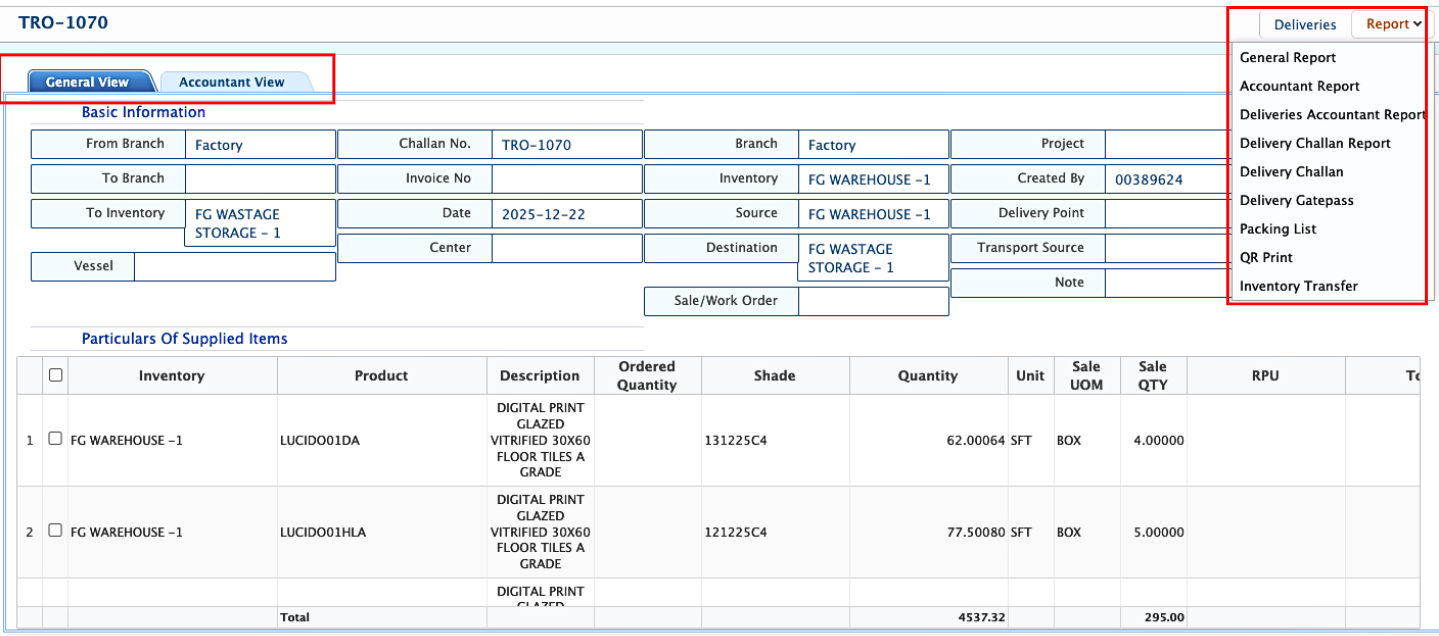
Clicking on a Transfer Request opens its Details Page, where users can easily review all relevant information. The General View shows key operational details such as the branch, inventory location, challan number, and particulars of supplied items, including product names and quantities. The Accountant View provides a clear overview of related ledger entries and financial records for accurate accounting tracking. All transfer information can be compiled into reports, which can be viewed or downloaded in multiple formats.
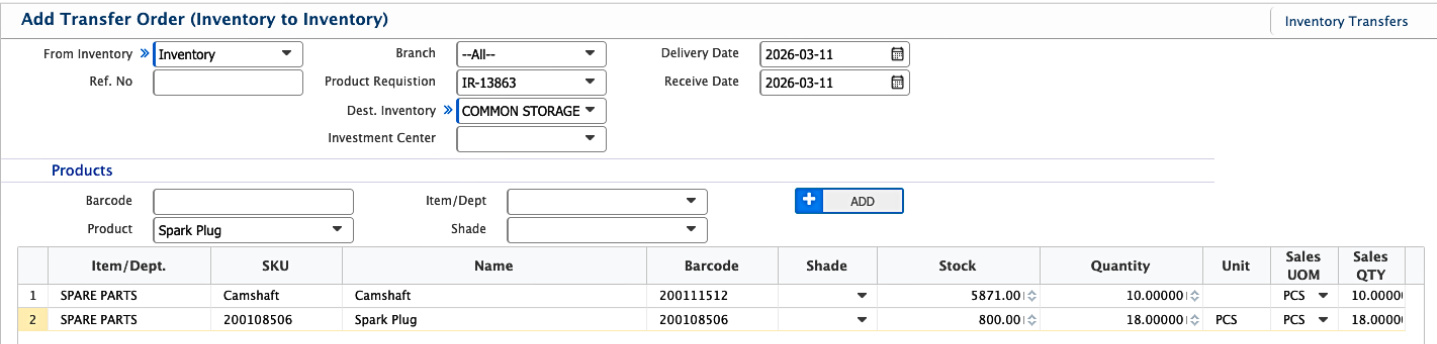
Add Transfer Order (Inventory to Inventory)
| Field | Action |
|---|---|
| From Inventory | Select the inventory location from which products will be sent. |
| Ref. No | Enter a reference number for the transfer order. |
| Branch | Select the branch associated with the transfer order. |
| Product Requisition | Select the related product requisition, if applicable. |
| Dest. Inventory | Select the destination inventory location to receive the products. |
| Investment Center | Select the investment or processing center handling the transfer. |
| Delivery Date | Select the date when the products are dispatched. |
| Receive Date | Select the expected date for the products to be received. |
| Products Barcode | Enter the barcode to search and add products to the transfer order. |
| Item/Dept | Select the relevant item or department associated with the product. |
| Product | Choose the product from the system’s product list for transfer. |
After a Transfer Order is added, it immediately appears in the Inventory Transfers List. Users can use the search panel to filter and locate a specific transfer order. Each order has a status reflecting its current stage: Pending, Accepted, Rejected, or Closed. Users can update the status at any point, and even edit an order after it has been closed if adjustments are needed. Once the transfer process is fully completed, the order can be marked as Closed to finalize it in the system.
Clicking on a Transfer Order opens its Details Page, where information is organized in two views. The General View displays operational details such as branch, from and destination inventory, delivery and receive dates, challan numbers, and particulars of transferred items. The Accountant View provides a clear overview of related ledger entries and financial records. Users can also generate transfer-related reports, which can be viewed or downloaded in multiple formats.